Article by Brianna Randall, National Wildlife Federation
Published March 26th, 2026
https://www.nwf.org/Home/Magazines/National-Wildlife/2026/Spring/Gardening/Native-Plant-Laws
Homeowners and NWF affiliates are fighting to change restrictive local landscaping laws in favor of native plants
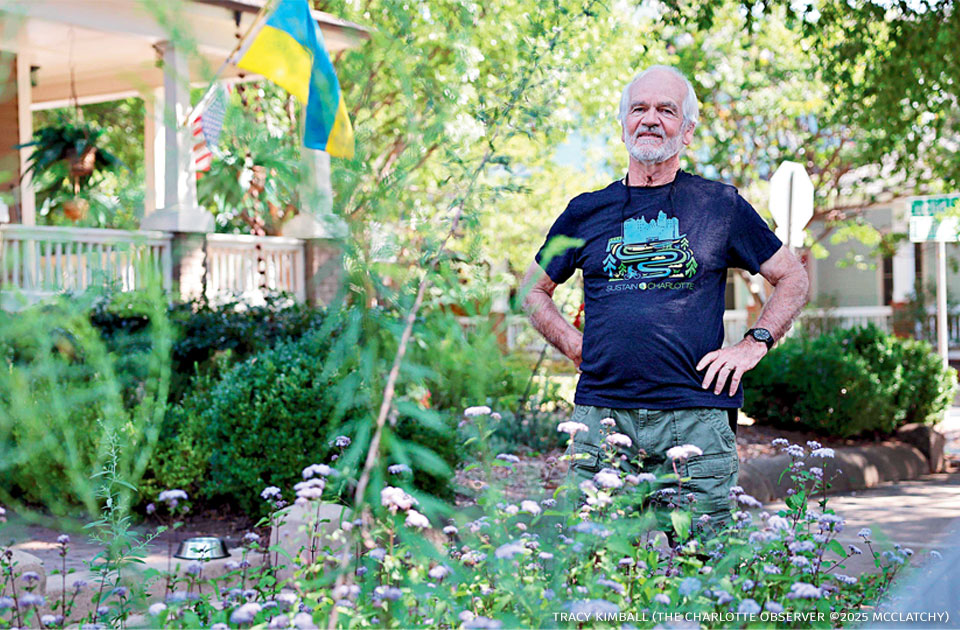
Lou Lesesne stands in his Charlotte, North Carolina, front yard (above), which brims with sundrops, coneflowers and other nectar-rich plants that support pollinators such as sweat bees.
FIVE YEARS AGO, when Lou Lesesne moved to a new house in Charlotte, North Carolina, he decided to “get rid of the grass and bring in the pollinators.” Today, his yard boasts expansive beds of ironweed, purple and cutleaf coneflower and other native plants that support native wildlife. “I like to do my part to help the birds and the insects find habitat,” Lesesne says.
This past June, however, Lesesne received a letter from the city of Charlotte warning him he was in violation of a property-maintenance code requiring homeowners to keep nonwoody plants shorter than 12 inches. The city told him to mow down his natural garden or pay a fine of up to $500.
His experience is hardly unique. Across the country, wildlife-friendly gardeners are running afoul of local laws that prioritize “nice, tidy green lawns that are mowed low to the ground,” says Patrick Fitzgerald, the National Wildlife Federation’s senior director of community habitat.
But thanks to advocacy efforts by homeowners like Lesesne—often in collaboration with NWF affiliates—such rules increasingly are being challenged and subsequently repealed or revised. “We’re seeing a lot of momentum to change local landscaping ordinances, especially as more people bump up against rules that don’t allow them to grow native plants,” Fitzgerald says.
Dating back to the early 1900s, municipal property maintenance ordinances are intended to keep neighborhoods looking cared for and neat. The rules often prohibit homeowners from growing nonwoody plants above a certain height, typically 10 to 12 inches. But that requirement stymies the efforts of gardeners who choose natural landscaping. Native plants can grow several feet high—and need to before they can flower and reseed. When mature, some of the ironweeds adorning Lesesne’s yard, for example, can stretch up to 10 feet tall. Allowing such plants to reach their full height provides the pollen, nectar, seeds and other food wildlife need, as well as vertical structure that creates habitat for a variety of species, from insects and birds to reptiles and amphibians.
When Lesesne received his citation, he contacted the North Carolina Wildlife Federation (NCWF), an NWF affiliate, for advice on how to save his native plants. He wasn’t the only one, and NCWF has been happy to help. Changing municipal ordinances to encourage natural landscaping is “commonsense conservation,” says Alden Picard, NCWF’s conservation coordinator, who has fielded dozens of calls, emails and visits from concerned native gardeners like Lesesne. “This is something everyone can get behind. It’s a gardening for wildlife campaign. It’s a campaign to let our milkweed, ironweed and joe-pye weed grow tall, flower and go to seed,” he says.
In July 2025, NCWF joined forces with six other local and state conservation groups to create the Coalition to Protect Our Urban Nature. The coalition successfully rallied residents of Charlotte to submit several hundred comments as well as attend public forums to lobby for exempting native gardens from the city’s vegetation-height requirement
Ed Murray, a Charlotte homeowner with more than 100 native plants in his yard, testified on behalf of the proposed change at a city council meeting in fall 2025. He framed native landscaping as a family issue that benefits children. “We live in a very urban area, so it’s not like you can drive 10 minutes and get a lot of biodiversity. But you can still have a place where your kids go out into the yard and see interesting things,” he says. Murray believes that interacting with the native plants, insects and birds in their yard gives his 4-year-old daughter “a significant leg up in understanding the way the world works.”
Charlotte Mayor Vi Lyles found such testimonies so convincing that, last October, she pledged to exempt native plant gardens from the vegetation-height requirement. This February, the city council approved the change, paving the way for homeowners in the nation’s 14th largest city to create more wildlife-friendly gardens.
Another North Carolina city, Winston-Salem, passed a similar ordinance in 2025. Next up, Murray hopes the Charlotte coalition sets its sights on requiring native plants—and prohibiting the planting of invasive species—on city-owned properties, a policy adopted by Greensboro, North Carolina, in 2024.
In South Carolina, another NWF affiliate, the South Carolina Wildlife Federation (SCWF), also is helping reshape rules in the state capital, Columbia, to help homeowners grow—not mow—native gardens. After hearing complaints that residents were being penalized for growing native plants, SCWF teamed up with the Gills Creek Watershed Association and the South Carolina Native Plant Society Midlands Chapter to lobby the city to change its property maintenance ordinance. In May 2025, Columbia amended its rules so that homeowners certified through a recognized program, such as NWF’s Certified Wildlife Habitat® program, can register their yard with the city to avoid fines.
“South Carolina is one of the fastest-growing states. It’s more important than ever that we are able to replace some of the habitat that’s removed when new neighborhoods are built,” says Sara Green, SCWF’s executive director. When homeowners re-create lost habitat by planting native gardens, she adds, it benefits at-risk wildlife, including songbirds and native pollinators. Green has received requests from several other NWF affiliates seeking to change their local landscaping rules.
To support such efforts, NWF published the Guide to Passing Wildlife-Friendly Property Maintenance Ordinances in 2021. “The National Wildlife Federation prioritizes landscaping ordinances because they represent a key lever for increasing native plant habitat in communities,” Fitzgerald says, adding that “there’s been a recent groundswell of interest in advancing local policy changes to benefit wildlife.” In the coming year, he says, NWF will survey its affiliates to assess local advocacy efforts underway, including which of them can be replicated elsewhere.
Legalizing protections for wildlife-friendly gardens at the city level “is a much better return on investment than trying to change rules one homeowners association at a time,” Picard says. “It’s time for local government to wake up, to move forward, so that we have monarchs and bumble bees and songbirds in our yards 50 years from now.”
Banner image by Dave Ozric