By Sara Green, SCWF Executive Director
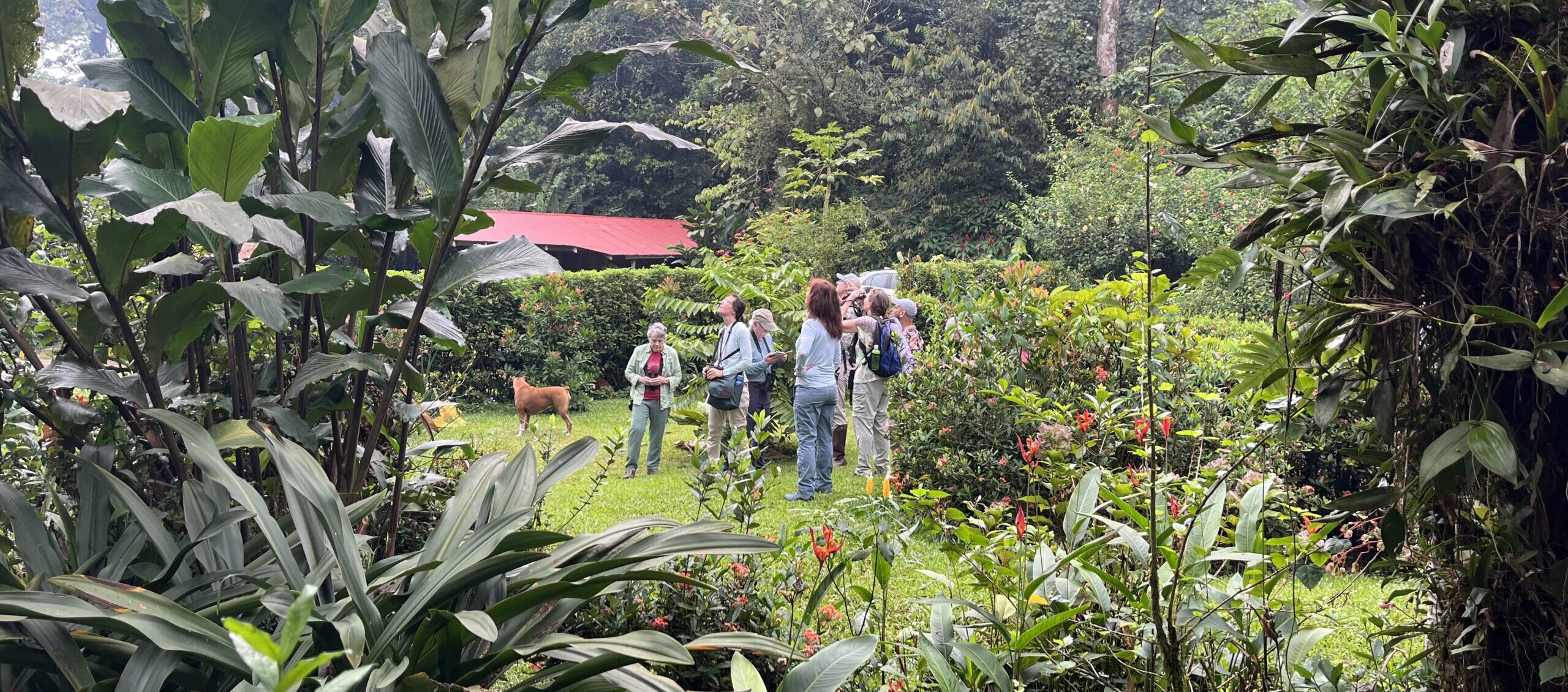
Earlier this month, SCWF took an amazing group of birders on a fantastic trip to Costa Rica! I got to tag along and help with logistics, and Jay Keck, our Industry Habitat Manager, speaks Spanish in addition to being a bird expert – so he was a great bird guide! These annual SCWF trips to Costa Rica help to tie together conservation efforts here in South Carolina with those in Costa Rica where several neotropical migrants spend their winters and/or migrate through Central America. We were inspired by the intentional emphasis that Costa Rica places on ecotourism, carefully managing wildlife preserves and training guides to take tourists to see the beautiful landscapes and incredible biodiversity while not jeopardizing the pristine areas.
Our group was excited to explore the northern, mountainous part of Costa Rica together, and we saw amazing birds and other wildlife. They had a variety of levels of birding experience, some chose to focus more on photography or hiking, and some checked “lifers” off their extensive bird lists.
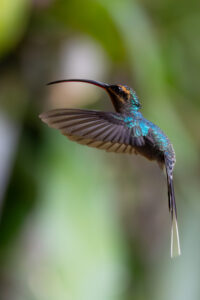
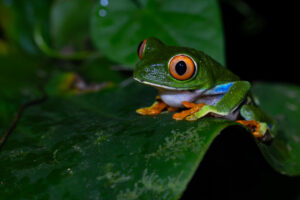
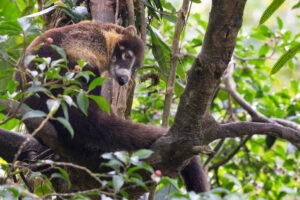
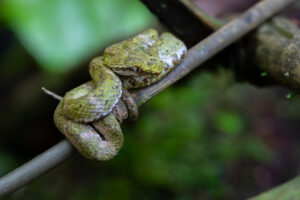
On this trip, we ended up with 162 species of birds (see entire list below), including 13 species of hummingbirds and 4 species of kingfishers! We also saw a few tapirs, howler monkeys, caimans, coatis, red-eyed treefrogs, eyelash vipers and even two fer-de-lances!
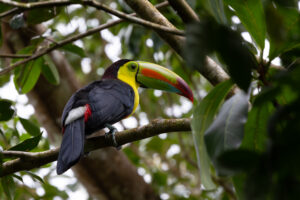
The wonderful nature-based La Carolina Lodge was our home base, and we took day trips to birding hot spots in the Guanacaste Region. The Lodge was built from wood on the property, and our meals were prepared deliciously with fruits, vegetables, eggs and meat from their farm and greenhouse. Every day, the staff would build fires for cooking and heating hot tubs, and they lit candles which lined the paths in the evenings, producing a beautiful and relaxing atmosphere to end the day. The sounds of the Montezuma oropendola were delightfully ever-present during the day, and toucans and honeycreepers came to the fruit feeders.
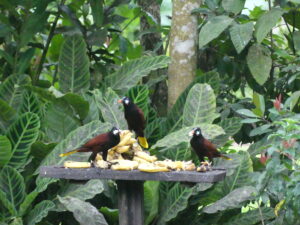
For our first day of birding, we stayed right there on the grounds of the Lodge – there were so many amazing habitat types and edges there! We hiked through meadows where horses and cows grazed, along the forested edges of the creek, and through the property’s numerous gardens. We met our amazing local guide, Jorge, from Bijagua Birdwatching, who was a wealth of knowledge about birds, as well as many plants, insects, etc., and the culture of the area. He brought along a spotting scope to allow us all to have a great view of the birds. This property was a great location for our group to begin to recognize many of the common birds at a leisurely pace.
The Caño Negro Wildlife Refuge was our destination for day two, and we were treated to a boat ride through the Caño Negro Wetland – one of the most dynamic and biodiverse ecosystems in Costa Rica. Traveling to this Refuge allowed us to see numerous water birds that we would not otherwise have seen on this trip – bare-throated tiger heron, boat-billed heron, black-necked stilts, jabaroo, and four species of kingfishers. This is where we saw numerous caimans and iguanas, in addition to a couple green basilisks and white-faced capuchin monkeys.
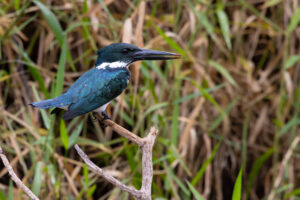
Day three took us to the Cataratas Bijagua Lodge which is set on the lush slopes of the Miravalles Volcano and the banks of the Bijagua River in the Guanacaste Province. The parking lot was surrounded by a garden which attracted a great variety of hummingbirds and the lodge had hummingbird feeders which gave us great looks at them up close. Highlights there were the violet saberwing and the black-crested coquette. We saw a white hawk perched on a low tree in the gardens for us to easily see and marvel at. A hike to see the Bijagua River waterfall tired us all out, and we had time to rest in the afternoon back at La Carolina Lodge.
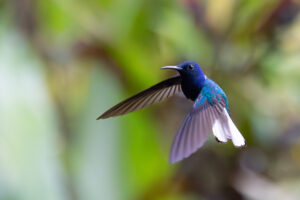
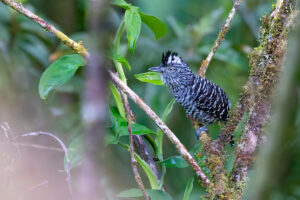
On day four, we drove a short distance to Tapir Valley, which is carefully managed for the native, nocturnal mammals for which the preserve was named. Upon arrival, we quickly hiked to catch a glimpse of 2 tapirs before they bedded down for the day. We then visited some areas in the valley where we saw several different species of hummingbirds (highlight – a snowcap!), and then our group was treated to delicious snacks at an overlook where we watched a great diversity of birds at the fruit feeders. We then continued the hike around the valley and saw many more new birds, another highlight was the barred antshrike, both male & female! On the way back to the Lodge, we stopped in the nearby town of Bijagua for souvenirs, snacks, and cash for tips. We were treated to a night hike back at Tapir Valley later that evening, and saw a tapir out in the open feeding, as well as several species of frogs, lizards and snakes!
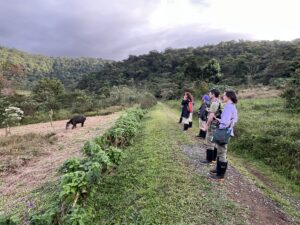
The fifth day was a planned “free” day and folks were free to make arrangements to visit nearby cocoa farms, go horseback riding or zip lining, rent a car and travel to another area, etc. Some folks went to visit Rio Celeste, Costa Rica’s most famous turquoise waterfall. Others went to the cocoa farm, and some went back to Catarata Bijagua for more birding, where they spotted a sloth, too!
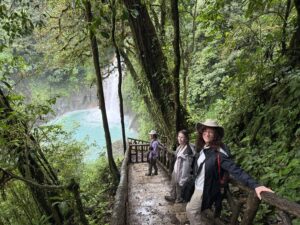
Each of those days, we rose early to go birding, usually taking “breakfast” with us in the form of granola bars, fruit and nuts. We’d typically be back to the Lodge by early- to mid-afternoon to rest and cool off in the river before dinner. Most days included 5+ hours of birding, 2-4 miles of hiking (sometimes with considerable elevation change and uneven footing), and we ended up with light rain each day, even though it was the dry season. We carried lots of water and snacks, and found some incredible places to eat when we were away from the Lodge.
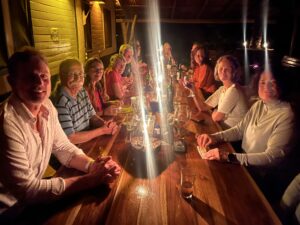
The Lodge does not have air-conditioning, but every room has a ceiling fan and at least one floor fan, and multiple screened windows to help with airflow. The creek that runs through the property is nice and cold and refreshing, and has easy access by stairs. Dips in the creek, plenty of showers, and all the fans and open windows allowed us to keep cool. The beds also have mosquito nets above them, and I figured they were there for a reason, so I used them every night. But, we did not have much of an issue at all with insects, either at the Lodge or on any of our excursions.
This trip is definitely geared toward birding – while we did stop to check out all mammals and reptiles, we did not spend much time on all of the amazing tropical plants along our hikes. Our guides Jorge and Jay were very focused on helping the group see as many different birds as possible.
Here is the complete list of birds from our trip:
- Red-billed pigeon
- Short-billed pigeon
- Pale-vented pigeon
- Ruddy ground dove
- White-winged dove
- White-tipped dove
- Common Squirrel Cuckoo (heard)
- Groove-billed ani
- Southern lapwing
- Russet-naped wood rail
- Black-crowned night heron
- Green heron
- Tricolored heron
- Great blue heron
- Little blue heron
- Boat-billed heron
- Bare throated Tiger heron
- Great egret
- Snowy egret
- Wood stork
- Jabaroo
- Broad-winged hawk
- Yellow-headed caracara
- Crested caracara
- Great black hawk
- Gray hawk
- White hawk
- Roadside hawk
- Black-collared hawk
- Laughing falcon
- Swallowtail kite
- White kite
- Osprey
- Keel-billed motmot
- Ringed kingfisher
- Amazon kingfisher
- American Pygmy kingfisher
- Green kingfisher
- Gray-headed chachalaca
- Crested guan
- Great curacao
- Black-bellied whistling duck
- Muscovy duck
- Blue-winged teal
- Least grebe
- Sun grebe
- Tropical cormorant
- Anhinga
- White ibis
- Green ibis
- Spotted sandpiper
- Northern jacana
- Black-necked stilt
- Purple gallinule
- White-collared swift
- Lesser swallow-tailed swift
- Long-billed hermit
- Stripe-throated hermit
- Scaly-breasted hummingbird
- Rufous-tailed hummingbird
- White-necked jacobin
- Green hermit
- Black-crested coquette
- Violet-headed hummingbird
- Violet saberwing
- Crowned wood nymph
- Blue-throated golden tail
- Bronze-tailed plumeleteer
- Snowcap
- Cattle egret
- Black vulture
- Turkey vulture
- King vulture
- Gartered trogon
- Slaty-tailed trogon
- Rufous-tailed jacamar
- Collared aracari
- Yellow-throated toucan
- Keel-billed toucan
- Black-cheeked woodpecker
- Hoffman’s woodpecker
- Golden-olive woodpecker
- Smokey brown woodpecker
- Orange-chinned parakeet
- Crimson-fronted parakeet
- Olive-throated parakeet
- Red-lored amazon
- White-fronted amazon
- Southern mealy amazon
- Chestnut-backed antbird
- Barred antshrike
- Streak-headed woodcreeper
- Masked tityra
- Common Tody flycatcher
- Black-headed tody flycatcher
- Cinnamon becard
- Yellow olive flatbill
- Black phoebe
- Mistletoe tyrannulet
- Yellow tyrannulet
- Bright-rumped Attila
- Great kiskadee
- Social flycatcher
- Pyratic flycatcher
- Dusky-capped flycatcher
- Ringed flycatcher
- Great-crested flycatcher
- Yellow-bellied flycatcher
- Yellow-bellied elaenia
- Long-tailed tyrant
- Tropical kingbird
- Tropical mockingbird
- Philadelphia vireo
- Lesser greenlet
- Northern rough-winged swallow
- Southern rough-winged swallow
- Mangrove swallow
- Blue & white swallow
- Southern house wren
- Bay wren
- White-breasted wood wren (heard)
- Nightingale wren (heard)
- Clay-colored thrush
- Wood thrush
- Yellow-throated euphonia
- Black-striped sparrow
- Orange-billed sparrow
- Montezuma oropendola
- Great-tailed grackle
- Nicaraguan grackle
- Melodious blackbird
- Baltimore oriole
- Mourning warbler
- Yellow warbler
- Chestnut-sided warbler
- Buff-rumped warbler
- Black-and-white warbler
- Tennessee warbler
- Olive-crowned yellow throat
- Louisiana waterthrush
- Northern waterthrush
- Prothonotary warbler
- Tropical parula (heard)
- Scarlet-rumped tanager
- Crimson-collared tanager
- Blue gray tanager
- Palm tanager
- Summer tanager
- Golden-hooded tanager
- Red-throated ant tanager
- Carmiol’s tanager
- Red-legged honeycreeper
- Shining honeycreeper
- Green honeycreeper
- Rufous-winged tanager
- Blue-black grosbeak
- Black-faced grosbeak
- Variable seedeater
- Morelet’s seedeater
- Bananaquit
- Yellow-faced grassquit
- Buffthroated saltator
Photos by Tracy Nunnery